
Quick Answer
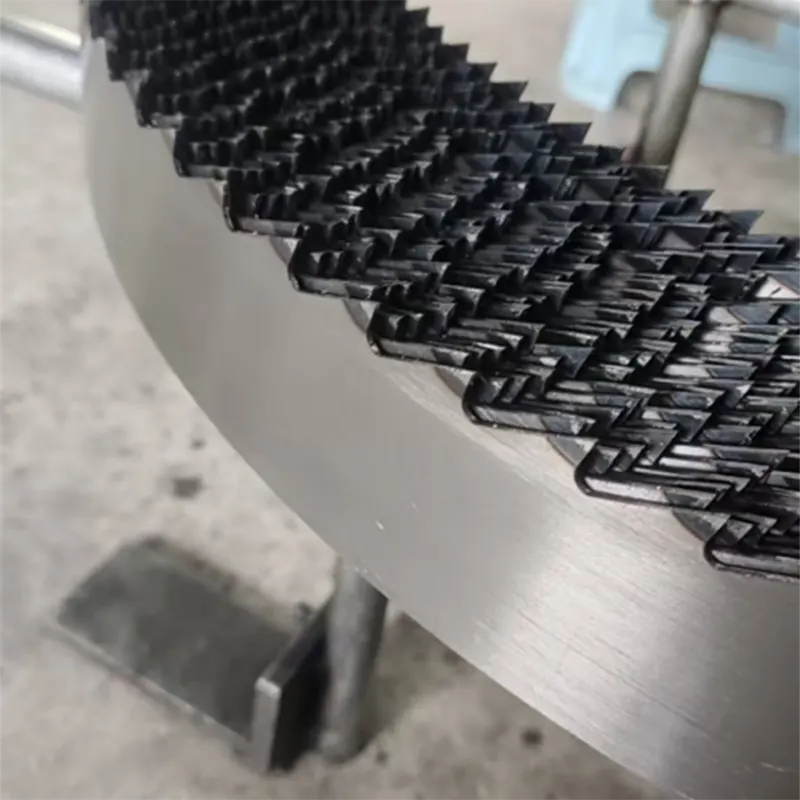
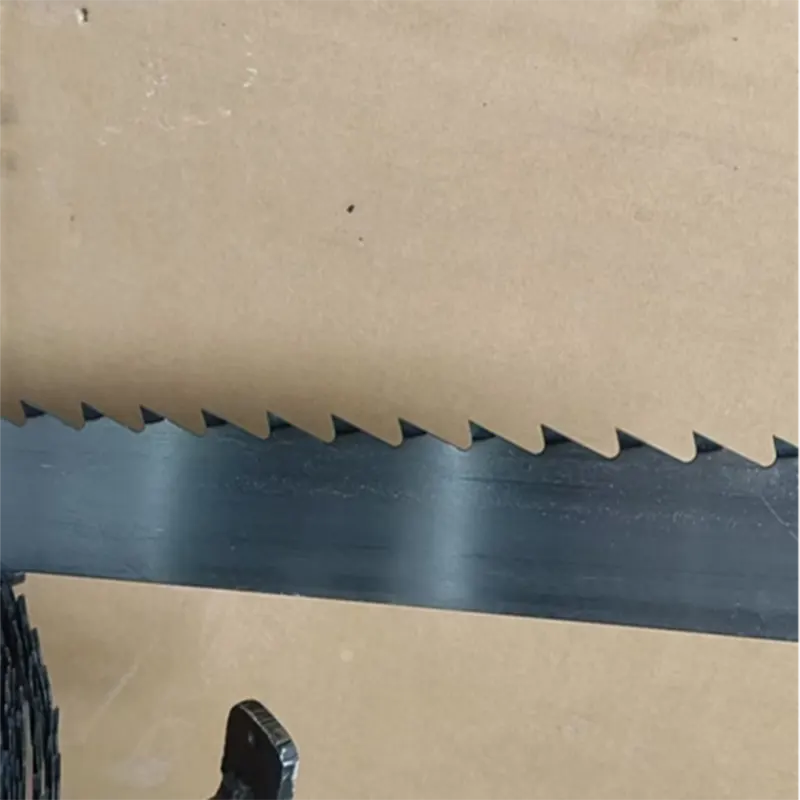
This is a band saw blade line engineered for high-density hardwood cutting. The blade body is selected from four alloy steels — C75Cr1, 51CrV4, 75Ni8 and D6A — according to the cutting condition, and is suitable for teak, rubberwood and other hardwoods in sawmill ripping and solid-wood furniture preparation. The selection logic is not “harder is always better.” The goal is to match wear resistance, fatigue strength and toughness to the specific hardwood’s density, silica/resin content and feed load. For high-silica or oily hardwoods, prioritize abrasive-wear resistance; for high-tension continuous sawmill operation, prioritize fatigue-crack resistance; for knotty, frozen or mixed hardwood, retain enough toughness to absorb impact. On tooth geometry, hardwood cutting generally starts with a lower hook angle (about 5°–10°) and a finer tooth pitch to control chip load per tooth and reduce tooth-root cracking and saw-path deviation.
1. Product Positioning: What Problem It Solves
The real cost in hardwood cutting is rarely “the blade cannot cut.” It is premature blade failure: fatigue cracks at the tooth root, early tooth-tip dulling, saw-path wander that causes dimensional rejection, and accelerated wear from resin or silica abrasives. A general-purpose band saw blade often delivers unstable life when cutting teak with silica deposits, dense rubberwood fibers, or kiln-dried hardwoods with high abrasiveness.
This product is designed around a different premise: treat material selection and tooth geometry as adjustable variables matched to hardwood conditions, rather than forcing one “universal” blade across all jobs. The target customers are hardwood processing plants, sawmills and solid-wood furniture factories — operations that share continuous production, sensitivity to blade-change frequency, and clear requirements for cut accuracy.
2. Core Specifications at a Glance
| Item | Content |
|---|---|
| Product name | Band Saw Blade for Hardwood Cutting |
| Optional blade body materials | C75Cr1, 51CrV4, 75Ni8, D6A |
| Suitable wood species | Teak, rubberwood and other hardwoods, including high-density and silica/oil-bearing hardwoods |
| Target applications | Sawmill ripping, continuous hardwood processing, solid-wood furniture preparation |
| Tooth geometry direction | Hardwood-matched pitch and hook angle (see Section 4) |
| Supply form | Customized to customer equipment specifications (length, width, thickness and tooth geometry to be confirmed by inquiry) |
| Standard reference | Blade body materials can be mapped to cold-rolled alloy steel standards such as DIN EN 10132-3+4 |
3. How to Choose Among the Four Blade Body Materials
There is no absolute “best” material — only differences in fit to the operating condition.
| Material | Standard / equivalent reference | Composition feature (core alloying elements) | What it means for hardwood cutting | Preferred scenario |
|---|---|---|---|---|
| C75Cr1 | DIN 1.2003 | C 0.70–0.80%, Cr approx. 0.40% | Chromium provides some resistance to temper softening and wear; carbon content supports baseline hardness. A mature choice for band saw blade bodies. | Routine hardwood ripping where wear resistance and cost balance matter |
| 51CrV4 | DIN 1.8159 / SAE 6150 | Cr-V alloy system | Vanadium refines grain structure and supports a favorable combination of fatigue strength and toughness. Fatigue resistance under repeated bending is the core value in band saw operation. | High-tension, continuous production, sawmill conditions sensitive to blade breakage |
| 75Ni8 | DIN 1.5634 | Ni 1.80–2.10% | Nickel significantly improves toughness and hardenability; provides tolerance under knotty, frozen or impact-loaded cutting. | Knotty hardwoods, frozen timber, fluctuating feed conditions |
| D6A | DIN 1.2791 | Dedicated band saw steel system | A steel grade oriented to band saw blade applications, emphasizing balance between body strength/toughness and fatigue life. | Hardwood lines requiring high overall performance and fewer material changes |
Recommended decision order: first identify the failure mode. If blades are removed because of tooth-tip wear, lean toward C75Cr1 or a more wear-resistant configuration. If failure is tooth-root fatigue cracking or blade breakage, the toughness/fatigue advantages of 51CrV4 and 75Ni8 deserve priority evaluation. If the operation is highly variable with mixed incoming material (knots, frozen timber, mixed hardwood batches), the toughness margin of 75Ni8 is a practical way to reduce unplanned downtime. This logic is closer to the true cost structure of hardwood cutting than comparing hardness alone.
4. Tooth Geometry and Parameters: Baseline Direction for Hardwood
After material, tooth geometry is the variable with the greatest influence on hardwood cutting results. Hardwoods are dense with tight fibers. An excessively large hook angle or too-coarse pitch sharply raises chip load per tooth, and stress concentration at the tooth root leads directly to cracking and tooth breakage.
Hook angle / rake angle: For hardwoods, this should generally fall in a lower range. Industry guidance commonly lists 4°–10° for hardwoods, frozen timber and knotty material, with 10° often treated as a general starting point. Hook-tooth designs commonly use approximately 10° positive rake for a more aggressive bite, suitable for larger-diameter hardwood sawing. For silica-bearing, blade-dulling species such as teak, a very large hook angle is not recommended just to gain surface speed, because it accelerates edge wear and increases thermal load on the tooth tip.
Tooth pitch / TPI: Hardwood cutting spans a spectrum from “coarse ripping” to “fine finishing.” Toward the coarser end, 4–6 TPI or variable-pitch blades with 4–6 mm pitch are used to reduce cutting resistance and extend life. Toward the finer end, 6–8 TPI is used for hardwood finishing, and 10–14 TPI for fine cutting to reduce tear-out. For sawmill ripping, a coarser pitch with a lower hook angle is the more common starting point. For solid-wood furniture preparation and fine cutting, move toward a finer pitch to improve cut quality. This page does not claim a single “correct” value, because recommendations vary with machine power, blade width, wood moisture content and feed strategy. The actionable baseline is: start hardwoods in the 4–8 TPI range and the 5°–10° hook-angle range, then converge based on first-run deviation, cut-surface quality and tooth-edge wear.
Linear speed and feed: Hardwood cutting usually runs at lower linear speed than softwood. Practical references suggest 22–26 m/s linear speed and 1.5–2.5 m/min feed for hardwoods such as birch and maple, with coolant to reduce thermal damage. Teak’s silica content and rubberwood’s dense structure both amplify overheating risk, so “slower rather than faster” is often the more economical strategy during first-run debugging on hardwoods.
5. Suitable Wood Species and Customer Scenarios
Teak: Hardness is not the highest, but silica deposits act as an abrasive on the cutting edge, making it a “fast-dulling” hardwood. Material and tooth geometry should prioritize edge retention; avoid overly aggressive large hook angles that accelerate dulling.
Rubberwood: Janka hardness is approximately 960 lbf (4,280 N). Density and fiber tightness directly affect cutting-load transmission. In continuous ripping, the blade’s fatigue strength and tooth-root crack resistance are as important as wear resistance.
Target customer scenario matching:
-
Hardwood processing plants: Frequent species changes require a clear material and tooth-geometry selection logic to avoid the life penalty of “one blade for everything.”
-
Sawmills: Continuous high-tension operation makes blade-break downtime expensive; the fatigue/toughness advantages of 51CrV4 or 75Ni8 have clear economic significance.
-
Solid-wood furniture factories: Preparation accuracy and cut quality directly affect downstream machining allowance. Tooth pitch should move toward the finer side, combined with stable feed control.
6. FAQ
Q1: Is a harder band saw blade always better for hardwood?
No. Wear is not the only failure mode in hardwood cutting. Tooth-root fatigue cracking and blade breakage often cause greater downtime loss than simple dulling. Material selection must match wear resistance with fatigue toughness, rather than pursuing hardness in one direction.
Q2: How do I choose between C75Cr1 and 51CrV4 for hardwood cutting?
If the main failure is tooth-tip wear and the operation is relatively stable, C75Cr1 is a mature, cost-effective wear-resistant choice. If blade breakage or tooth-root fatigue is the main pain point, or if machine tension is high and production is continuous, the Cr-V system of 51CrV4 deserves priority evaluation for its fatigue strength and toughness combination.
Q3: The blade dulls quickly when cutting teak. Is it a material problem?
Teak contains silica, which has an abrasive wear effect and accelerates dulling of any cutting edge. Material upgrades can slow the process, but tooth geometry and feed strategy are equally important: an excessively large hook angle raises thermal load and mechanical impact at the edge, which can shorten effective life instead. Start with a lower hook angle and moderate pitch, and control first-run feed speed.
Q4: What TPI should I use for hardwood?
There is no fixed value. Coarse ripping commonly uses 4–6 TPI or variable-pitch designs with 4–6 mm pitch to reduce resistance. Fine cutting can move to 6–8 TPI or even finer. A more reliable approach is to start in the 4–8 TPI range and make small adjustments based on cut-surface quality, saw-path deviation and tooth-edge wear rate.
Q5: Do you provide samples or trial-cutting support?
Products are configured to equipment specifications and operating conditions. Before bulk purchase, provide machine parameters, target wood species and current failure mode so the material and tooth-geometry direction can be confirmed and a trial cut arranged. Specific MOQ, lead time and sample policy are subject to inquiry.


