
Product Overview in One Sentence
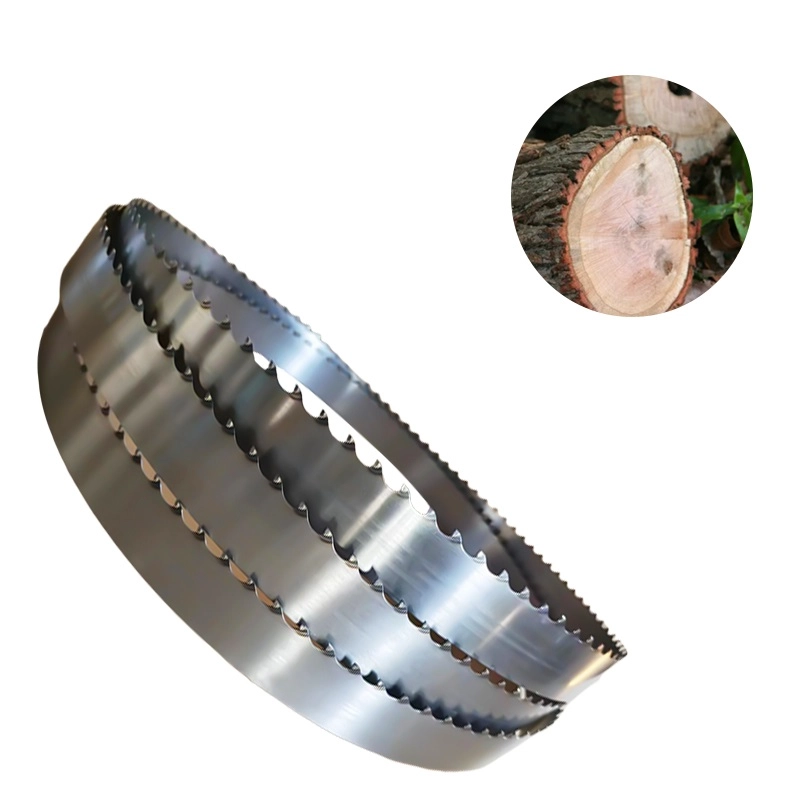
Wide band saw blades for timber resawing are circular-format bandsaw blades engineered for log breakdown and resawing thick boards into thinner stock in large sawmills, available in widths from 100–280 mm and manufactured from C75, C75Cr1, 51CrV4, or 75Ni8 alloy steel strip. They maintain straight-line cutting accuracy and fatigue resistance under high tension and continuous heavy-load operation. Unlike narrow bandsaw blades, the wide format delivers greater beam strength and drift resistance, making it the core consumable for large cross-section timber cutting.
Why Wide Resawing Demands a Purpose-Built Blade
Large sawmill resawing is not “occasionally cutting a thick board”—it is an industrial duty cycle of hours of continuous tensioned running per day, impact loading, and repeatable straightness on every cut. Conventional narrow bandsaw blades lack sufficient lateral rigidity above roughly 100 mm cutting width, leading to kerf drift, washboard surfaces, and premature fatigue failure.
The engineering logic of wide band saw blades centers on three variables:
① Beam strength and drift resistance. The greater the width, the stronger the blade’s resistance to lateral bending. Industrial resaw blades typically range from 50–260 mm in width; 100 mm is the threshold for genuine wide-format resawing—below this, blades are better suited to small-to-mid sawmills or curve cutting. Above 100 mm, the blade has the rigidity foundation to stably resaw large-section hardwood and softwood.
② High-tension load capacity. Wide band saw blades must run at tension stresses on the order of 25,000–28,000 psi to achieve adequate cutting stability. The hardenability and fatigue strength of the strip material directly determine how long it can sustain this stress level without fatigue fracture.
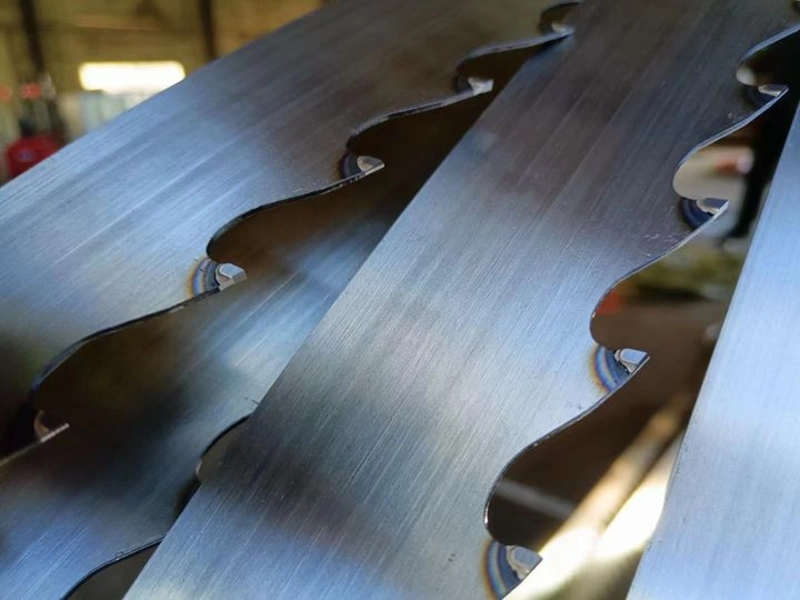
③ Compatibility with swaged tooth manufacturing. The dominant tooth format for industrial wide resaw blades is the swaged tooth—the tooth tip is formed by swaging rather than grinding alone, producing a kerf of approximately 0.9–1.0 mm, with a single swage typically lasting 3–5 re-grinds. Swaging requires the strip material to retain sufficient toughness at elevated hardness, or the tooth root will crack during swaging and service. This is precisely why 75Ni8 is regarded by the industry as the “decisive choice” for wide band saw blades.
Choosing Among Four Strip Materials: C75 / C75Cr1 / 51CrV4 / 75Ni8
This is the most critical distinction in the purchasing decision. The four grades are not a simple “step-up” hierarchy—they correspond to different performance priorities and cost positions.
| Material Grade | Core Alloy Characteristics | Performance Position in Wide Resawing | Best-Fit Applications |
|---|---|---|---|
| C75 | High carbon (0.70–0.80% C), no deliberate Cr/V/Ni additions | Baseline industrial grade. Meets hardness requirements, tougher than 75Ni8 at equivalent hardness, but limited hardenability and fatigue strength | Softwood-dominant resawing, moderate impact loads, cost-sensitive lines |
| C75Cr1 | ~0.4% Cr | The “upgraded standard” over C75. Improved hardenability and wear resistance, better strength, suited to narrow-to-medium width quality blades | Lines seeking a lifespan upgrade from C75 while remaining at moderate widths |
| 51CrV4 | ~1% Cr, 0.10–0.20% V | Best balance of strength, toughness, and fatigue resistance. V refines grain structure; fatigue life markedly superior to C75Cr1 | High-performance wide blade strip for high tension, high line speed, and long continuous industrial runs |
| 75Ni8 | 1.8–2.2% Ni | The toughness and impact-resistance first choice for wide blades. Ni substantially improves toughness and hardenability, purpose-designed for swaged tooth manufacturing and fracture resistance | Wide resawing above 100 mm, hardwood/frozen/abrasive timber, the “decisive choice” for swaged-tooth blades |
Quick selection guide:
-
Primarily softwood log breakdown, prioritizing lowest per-blade purchase cost → C75 as an entry option, accepting shorter re-grind intervals.
-
Need to upgrade from C75 and improve wear resistance, with width requirements not exceeding moderate range → C75Cr1.
-
Line runs high speed, high tension, and requires the longest possible re-grind intervals, with ground or flat teeth → 51CrV4 offers a clear fatigue-life advantage.
-
100–280 mm wide format, swaged teeth, hardwood or high-impact conditions, with the core requirement of “no breakage, fewer blade changes” → 75Ni8 is the industry-proven grade for wide band saw blades.
Specifications
| Parameter | Range / Options |
|---|---|
| Strip Material | C75 / C75Cr1 / 51CrV4 / 75Ni8 (other grades available on request) |
| Recommended Width | 100–280 mm (existing specifications; matched to equipment wheel diameter and resawing task) |
| Typical Thickness | Wide resaw blade strip typically 0.9–1.5 mm; exact thickness matched to equipment tension capacity and cutting load |
| Tooth Type | Swaged tooth / flat tooth / ground tooth; swaged tooth is the mainstream choice for wide resawing |
| Tooth Pitch | Selected by species and feed rate; lower pitch typically used for thick-board resawing to ensure chip clearance |
| Kerf | Swaged tooth typically ~0.9–1.0 mm; swage width generally sustains 3–5 re-grinds |
| Strip Hardness | Reference for comparable sawmill steel strip: typically ~43±2 HRC; confirmed per grade and heat-treatment condition |
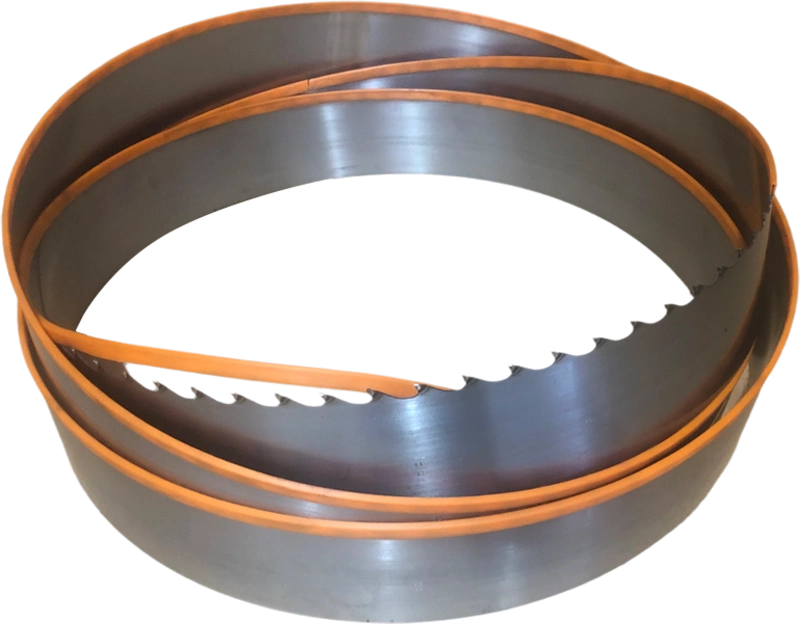
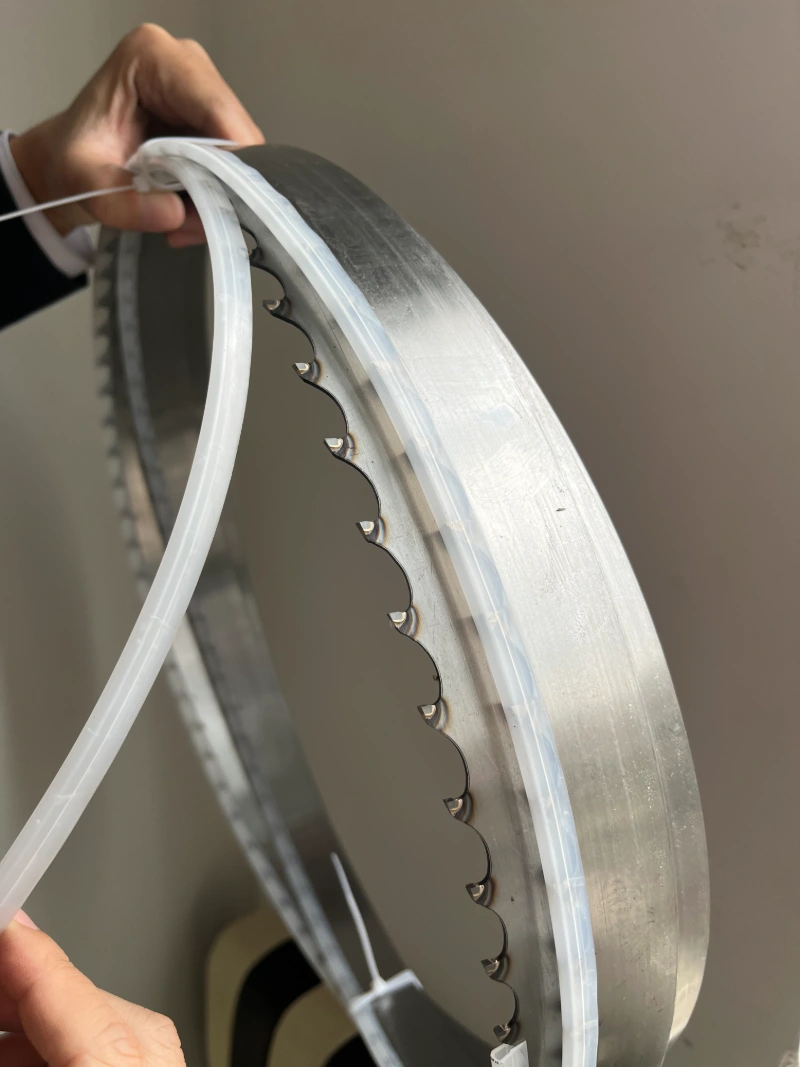
| Delivery Form | Coil supply or welded-to-length loops (customized to customer equipment circumference) |
| Compatible Equipment | Large vertical/horizontal band resaws, log band saws, heavy-duty resaws |
Applications: Who Should Use This Blade
Log breakdown in large sawmills. When converting logs into cants or large boards, wide band saw blades complete large cross-section cuts in a single pass, with kerf loss significantly lower than circular saws. Industry data shows combined sawmill losses from kerf, slabs, and edging at roughly 38% for band sawmills versus 48% for circular headrigs, because a circular saw removes two to three times more fiber per cut than a band saw. For sawmills whose core KPI is log volume yield, this gap translates directly into recovery rate.
Resawing thick boards into thin stock. When resawing thick boards or cants into multiple thin boards, the straightness retention of a wide band saw blade determines surface quality and downstream sanding allowance. Narrow blades tend to drift in large cross-section resawing; the wide format structurally suppresses this problem.
Hardwood, frozen timber, and highly abrasive wood. When wood hardness, silica content, or frozen condition raises both impact loading and abrasion rate, 75Ni8 or 51CrV4 strip paired with swaged teeth is the common solution for balancing “fracture resistance” and “wear resistance” in this duty.
Not recommended for: narrow resawing below 50 mm in small-to-mid sawmills, curve cutting, and intermittent light-load operations. These applications are adequately served by narrower blades; the rigidity and cost advantages of wide band saw blades cannot be realized, and they instead increase equipment tension burden.
Operating Economics: Don’t Just Look at “Price per Meter”
Wide resaw band saw blades are consumables, but their true cost unit is not “USD per meter”—it is cost per cubic meter of lumber or cost per thousand board feet.
Three metrics industrial buyers should track:
-
Lumber output per re-grind interval. A single swage sustaining 3–5 re-grinds means total service output per blade depends on “swage quality × number of re-grinds × effective cutting volume per re-grind.” The premium of 51CrV4 and 75Ni8 must be recovered through extended re-grind intervals or reduced unplanned blade changes.
-
Blade-change downtime cost. Each blade change on a large resaw involves shutdown, re-alignment, and test cuts; downtime loss often exceeds the purchase price differential of the blade itself. The value of reducing breakage and early failure is amplified on high-utilization lines.
-
The compounding effect of kerf loss. Every 0.1 mm reduction in kerf produces a significant recovery-rate difference on a line cutting hundreds of thousands of cubic meters annually. The kerf control capability of swaged teeth is directly tied to strip rigidity.
Current market price signals for wide industrial band saw blades generally fall in the US$3.50–7.00/m range, fluctuating with material (C75 → 75Ni8), width, tooth-type treatment, and order quantity; TCT or carbide-tipped products command higher prices. When requesting a quote, provide: cutting species, typical cross-section dimensions, equipment wheel diameter, target line speed, and current output per re-grind—so the optimal material and tooth profile can be matched, rather than quoting on width alone.
FAQ
Q1: What exactly is the difference between C75Cr1 and 51CrV4 in sawmill resawing?
C75Cr1 contains approximately 0.4% Cr, primarily improving hardenability and wear resistance as an upgrade over C75. 51CrV4 contains about 1% Cr with V additions; V refines grain structure, giving it a more balanced combination of strength, toughness, and fatigue resistance, with fatigue life superior to C75Cr1. If the line routinely runs high tension, high line speed, and long continuous operation, the 51CrV4 premium is typically recovered through fewer fatigue fractures and longer service cycles; if loads are relatively moderate and width requirements limited, C75Cr1 is the more cost-effective upgrade path.
Q2: Why is 75Ni8 considered the “decisive choice” for wide band saw blades?
75Ni8 contains 1.8–2.2% Ni. Ni’s enhancement of toughness and hardenability gives it outstanding fracture resistance when withstanding swaged-tooth manufacturing stresses and resawing impact loads. Among the failure modes of wide band saw blades, downtime losses from tooth-root cracking and strip fatigue fracture far exceed those from normal wear—75Ni8 is designed precisely to address this priority. It is not the highest-hardness option, but under the intersecting conditions of “wide format + swaged teeth + continuous industrial operation,” a toughness-first material strategy typically yields lower total cost of use.
Q3: What equipment/tasks do 100 mm and 280 mm correspond to?
100 mm is the entry width for wide-format resaw blades, suited to medium-duty resaws or resawing small-to-medium cross-section thick boards. 280 mm approaches the upper width limit of industrial log band saws and heavy-duty resaws, corresponding to large-diameter log breakdown or resawing of very large cants, requiring equipment with matching wheel diameter, tension capacity, and power. Selection should be constrained by the maximum blade width the equipment allows and typical cutting cross-section, not by pursuing greater width for its own sake.
Q4: How do you choose between swaged teeth and conventional ground teeth in wide resawing?
Swaged teeth form the tip and kerf through plastic deformation; the densified layer at the tooth tip is thicker, giving superior wear and chipping resistance under thick-board resawing and impact conditions; kerf is approximately 0.9–1.0 mm, and a single swage sustains 3–5 re-grinds. Ground teeth offer more consistent initial sharpness and suit applications demanding high surface finish, but edge retention in large cross-section continuous resawing is typically inferior to swaged teeth. The mainstream choice for wide industrial resawing is the swaged tooth.
Q5: What information is needed for an accurate material and tooth-profile recommendation?
At minimum: ① primary cutting species (softwood/hardwood/frozen, and whether silica or abrasive substances are present); ② typical cross-section dimensions (maximum and routine cutting width/height); ③ equipment parameters (wheel diameter, maximum tension, line speed range); ④ current blade specification and output per re-grind; ⑤ annual usage or single-order quantity. With this information, it can be determined whether C75 is sufficient, whether an upgrade to 51CrV4 or 75Ni8 is warranted, and how tooth pitch and swage parameters should be matched.


